

It’s hard to convince people that there’s any merit to protein that doesn’t come from an animal.
“It’s not complete.“
“It has too many carbs.”
“It contains antinutrients. It’s the natural enemy of nutrients!”
In a lot of Paleo circles, legumes are sometimes dismissively called “third world proteins,” food for those too broke for the good stuff. Putting aside how problematic that moniker is, in this article we’re going to explain why more athletes are looking to pea protein and why nutrition companies like Ample are making it the primary ingredient in products like the plant-based meal replacement Ample V.
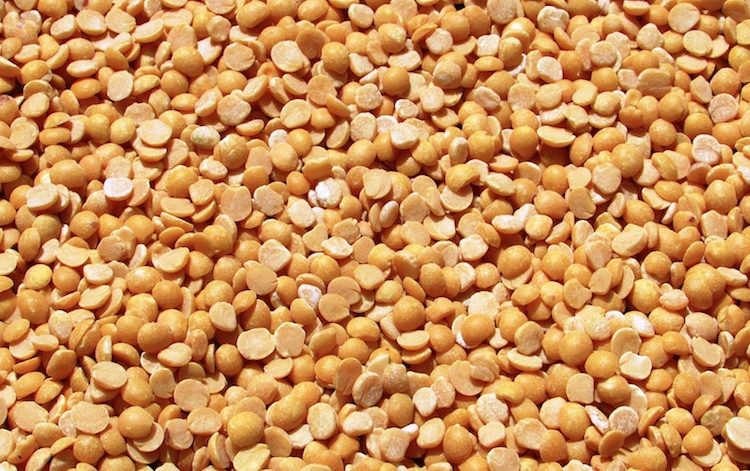
1. Pea Protein Is Really High Quality
A quick primer on what people mean by protein quality, or “completeness”: protein is made of amino acids and there are nine essential amino acids, meaning we have to consume them because we can’t make them ourselves. When a protein source has all nine in roughly equal amounts, it gets called “complete.” Complete proteins include meat, eggs, dairy, soy, quinoa, and a few others.
A cup of cooked peas has about 10 grams of protein and while, sure, it isn’t exactly “complete” because it’s a little low in methionine, it contains plenty of the branched chain amino acids leucine, isoleucine, and valine, which are the ones most closely linked to muscle gain.(1)
In addition, dietitians don’t really think you need to have a complete protein every time you eat; you only really need to get enough of the essential amino acids throughout the day, which you’re basically guaranteed to do without any effort if you’re eating a varied diet.(2)(3)
2. Pea Builds Muscle as Efficiently as Whey
The most common protein powder is milk-derived whey protein, and besides the fact that it’s pretty tasty, it’s considered high quality because it’s very high in branched chain amino acids.
Pea is actually so high in these amino acids that two studies published in the Journal of the International Society of Sports Nutrition and Sports found no difference in muscle gains when comparing pea protein with whey.(4)(5) The notion that it’s less effective for muscle gain simply doesn’t appear to be true.
Pea also has about three times as much arginine as whey. While arginine powder is not the most reliable pre workout supplement and evidence is mixed here, there’s still some research to suggest it might help with nitric oxide production and therefore improve blood flow.(6)(7)
[Learn more: Why More Athletes Should Look to Vegan Protein.]
3. Pea Digests Easily
The University of Michigan calls peas “unlikely allergens” for good reason. Dairy is a great source of protein, but plenty of people have allergies to lactose, casein, or other compounds in milk. Peas, by and large, are unlikely to cause digestive upset and they don’t contain any of the top eight allergens: peanuts, tree nuts, eggs, fish, shellfish, cow’s milk, wheat and soy.
Pea protein powder — which is usually made from yellow peas — also has much of the fiber removed, reducing the risk of causing bloating or gas.
Of course, this doesn’t mean everyone on Earth can happily digest peas — if you can’t stomach ‘em you can’t stomach ‘em. That said, when compared to other legumes, peas tend to be lower in some compounds that can cause digestive upset, such as the “antinutrient” phytic acid.
[Use the code BARBEND to save 15 percent when you order the pea-based meal shake Ample V.]
4. Antinutrients Aren’t That Big a Deal
Many diets, like Paleo and the Vertical Diet, minimize grains and legumes because they contain phytic acid. This is because it binds to positively charged metals, so it can reduce the absorption of minerals like magnesium, iron, and zinc.(8)(9)(10)
Again, peas are lower in phytic acid than other legumes. But even if they weren’t, phytic acid is also an antioxidant — some actually buy it in supplement form because it’s been linked to lower risks of cancer, cardiovascular disease, and kidney stones, perhaps because it helps to rid the body of excess calcium.(11)(12)(13) (There are some theories that this is why whole grains may lower the risk of colon cancer.(14))
If you still have issues with phytic acid, it seems the effects can be largely negated if you consume it with a small amount of Vitamin C — grab a banana with your shake and this should be fine.(15)(16)
5. Pea Protein May Confer Other Health Benefits
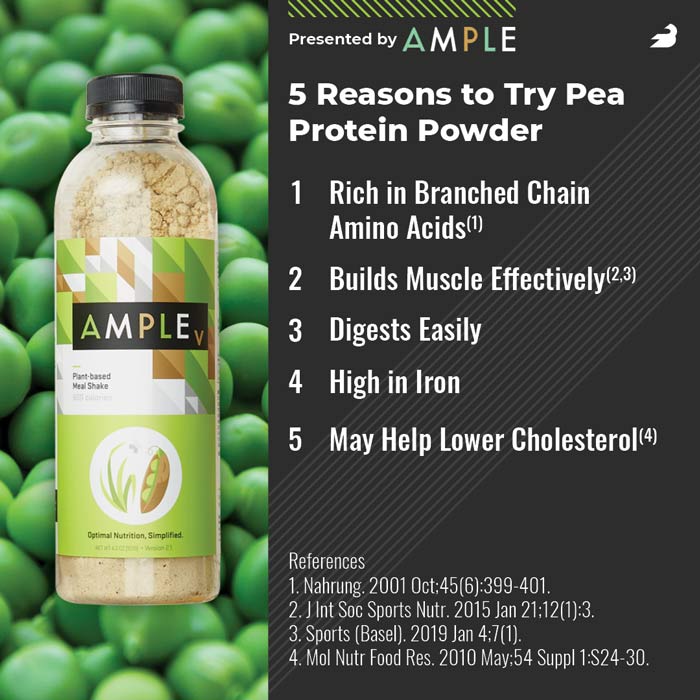
In addition to containing about a quarter of your daily iron intake per serving, some studies have found that just a few grams of pea protein hydrolysate per day can lower systolic blood pressure.(17)(18) Research performed on animals has also suggested that the supplement might help to reduce cholesterol levels as well, a quality often ascribed to legumes and whole grains.(19)(20)
Wrapping Up
We understand that a lot of people are apprehensive about the taste of pea protein, but it pairs well with earthier flavors like chocolate and/or peanut butter. (This is the case for a lot of other plant-based proteins as well, such as brown rice.)
Nonetheless, it is remarkable when a company puts out a pea-based protein drink that tastes fantastic, which is why we’re such huge fans of the plant-based meal replacement shake Ample V. It’s sweet, nutty, and is elevated by a large amount of coconut oil that brings a real smoothness to the flavor.
However you decide to take it, know that pea protein is inexpensive, hypoallergenic, healthful, and great for building muscle.
References
1. Tömösközi S, et al. Isolation and study of the functional properties of pea proteins. Nahrung. 2001 Oct;45(6):399-401.
2. Millward DJ, et al. The nutritional value of plant-based diets in relation to human amino acid and protein requirements. Proc Nutr Soc. 1999 May;58(2):249-60.
3. American Dietetic Association, et al. Position of the American Dietetic Association and Dietitians of Canada: Vegetarian diets. J Am Diet Assoc. 2003 Jun;103(6):748-65.
4. Babault N, et al. Pea proteins oral supplementation promotes muscle thickness gains during resistance training: a double-blind, randomized, Placebo-controlled clinical trial vs. Whey protein. J Int Soc Sports Nutr. 2015 Jan 21;12(1):3.
5. Banaszek A, et al. The Effects of Whey vs. Pea Protein on Physical Adaptations Following 8-Weeks of High-Intensity Functional Training (HIFT): A Pilot Study. Sports (Basel). 2019 Jan 4;7(1).
6. Böger RH, et al. Restoring vascular nitric oxide formation by L-arginine improves the symptoms of intermittent claudication in patients with peripheral arterial occlusive disease. J Am Coll Cardiol. 1998 Nov;32(5):1336-44.
7. Bailey SJ, et al. Acute L-arginine supplementation reduces the O2 cost of moderate-intensity exercise and enhances high-intensity exercise tolerance. J Appl Physiol (1985). 2010 Nov;109(5):1394-403.
8. Schuchardt JP, et al. Intestinal Absorption and Factors Influencing Bioavailability of Magnesium-An Update. Curr Nutr Food Sci. 2017 Nov;13(4):260-278.
9. Petry N, et al. In Rwandese Women with Low Iron Status, Iron Absorption from Low-Phytic Acid Beans and Biofortified Beans Is Comparable, but Low-Phytic Acid Beans Cause Adverse Gastrointestinal Symptoms. J Nutr. 2016 May;146(5):970-5.
10. Lönnerdal B. Dietary factors influencing zinc absorption. J Nutr. 2000 May;130(5S Suppl):1378S-83S.
11. Schlemmer U, et al. Phytate in foods and significance for humans: food sources, intake, processing, bioavailability, protective role and analysis. Mol Nutr Food Res. 2009 Sep;53 Suppl 2:S330-75.
12. Omoruyi FO, et al. The potential benefits and adverse effects of phytic Acid supplement in streptozotocin-induced diabetic rats. Adv Pharmacol Sci. 2013;2013:172494.
13. Grases F, et al. Phytate (IP6) is a powerful agent for preventing calcifications in biological fluids: usefulness in renal lithiasis treatment. Anticancer Res. 1999 Sep-Oct;19(5A):3717-22.
14. Aune D, et al. Dietary fibre, whole grains, and risk of colorectal cancer: systematic review and dose-response meta-analysis of prospective studies. BMJ. 2011 Nov 10;343:d6617.
15. Davidsson L. Approaches to improve iron bioavailability from complementary foods. J Nutr. 2003 May;133(5 Suppl 1):1560S-2S.
16. Siegenberg D, et al. Ascorbic acid prevents the dose-dependent inhibitory effects of polyphenols and phytates on nonheme-iron absorption. Am J Clin Nutr. 1991 Feb;53(2):537-41.
17. Li H, et al. Blood pressure lowering effect of a pea protein hydrolysate in hypertensive rats and humans. J Agric Food Chem. 2011 Sep 28;59(18):9854-60.
18. Girgih AT, et al. Antihypertensive Properties of a Pea Protein Hydrolysate during Short- and Long-Term Oral Administration to Spontaneously Hypertensive Rats. J Food Sci. 2016 May;81(5):H1281-7.
19. Rigamonti E, et al. Hypolipidemic effect of dietary pea proteins: Impact on genes regulating hepatic lipid metabolism. Mol Nutr Food Res. 2010 May;54 Suppl 1:S24-30.
20. Spielmann J, et al. Dietary pea protein stimulates bile acid excretion and lowers hepatic cholesterol concentration in rats. J Anim Physiol Anim Nutr (Berl). 2008 Dec;92(6):683-93.

